How Conversational AI Transforms Business Decision-Making Beyond Traditional Dashboards
- Dr. Anthony M. Young

- Jul 17
- 3 min read
Traditional dashboards have long been the backbone of business intelligence. Yet, they often demand that leaders know exactly where to look, which filters to apply, and how to interpret complex data sets. This process can slow decision-making and leave critical insights buried until the next report cycle. Conversational AI is changing this dynamic by enabling natural-language interaction with data, making analytics more accessible and actionable for business leaders.
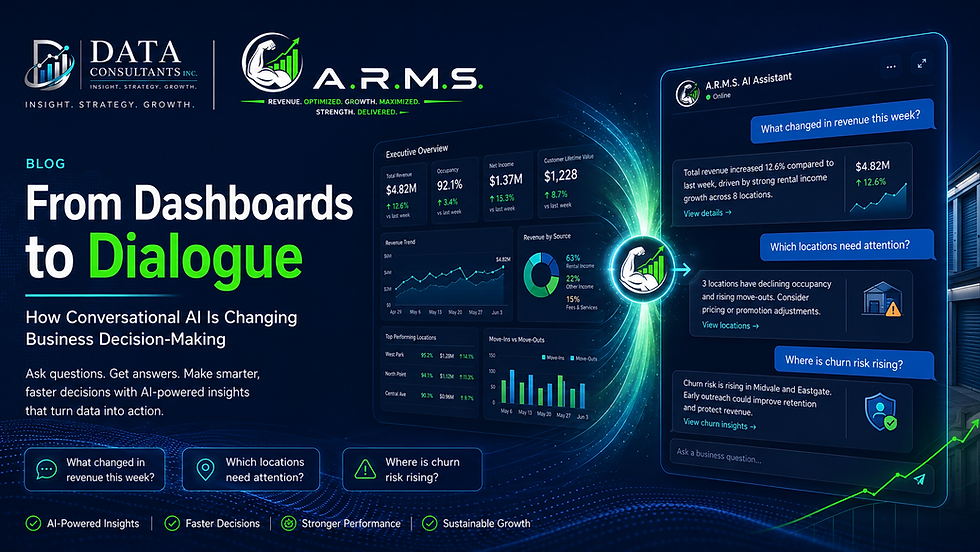
The Limits of Traditional Dashboards
Dashboards require users to navigate through multiple screens, select appropriate filters, and understand the context behind numbers. For example, a sales leader might need to manually compare weekly revenue across locations or identify where customer churn is rising. This process can be time-consuming and prone to oversight, especially when data volumes grow or when urgent decisions are needed.
Leaders often face questions such as:
Which locations need immediate attention?
What changed in revenue this week?
Where are churn or retention risks increasing?
Answering these questions quickly with traditional dashboards means knowing exactly where to click and how to interpret the results. This dependency on technical skills or data teams can delay insight and action.
Conversational Analytics: A New Way to Interact with Data
Conversational AI allows users to ask questions in plain language and receive instant, clear answers. Instead of hunting through dashboards, a business leader can simply ask:
"Which locations need immediate attention?"
"What changed in revenue this week?"
"Where are churn risks increasing?"
The AI understands the intent, pulls relevant data, compares trends, and delivers concise summaries. Users can then drill down further by asking follow-up questions or requesting comparisons, all without waiting for another report.
This approach supports faster insight and more dynamic decision-making. It also encourages exploration, helping leaders uncover hidden opportunities or risks that might otherwise go unnoticed.

The Value of an AI-Enabled Decision Layer
Adding conversational AI creates an AI-enabled decision layer that sits on top of existing data systems. This layer brings several benefits:
Faster insight: Instant answers reduce the time between question and action.
Stronger executive visibility: Leaders get clear, relevant summaries tailored to their needs.
Earlier detection of revenue leakage: AI highlights unusual patterns or declines before they escalate.
Improved forecasting: Natural-language queries help test assumptions and explore scenarios.
More consistent pricing: AI can analyze which pricing actions created the strongest net results.
Better alignment across teams: Operations, finance, and leadership share a common understanding based on trusted data.
For example, a pricing manager might ask, "Which pricing actions created the strongest net result last quarter?" The AI can analyze sales, margins, and customer response to provide a clear answer, helping refine pricing strategy.
Ensuring Trust and Governance in AI Insights
Conversational AI supports human judgment but does not replace it. For AI insights to be useful, the underlying data must be accurate, well-governed, and secure. This means:
Trusted data: Data sources must be reliable and up to date.
Governance: Clear policies control who can access and modify data.
Permission controls: Users see only the data they are authorized to view.
Explainability: AI responses should be transparent, showing how conclusions were reached.
Outcome measurement: Actions based on AI insights need to be tracked to evaluate effectiveness.
Without these safeguards, AI-driven decisions risk being based on incomplete or incorrect information, which can lead to poor outcomes.
Practical Examples of Conversational AI in Business
A regional manager asks, "Where are churn risks increasing this month?" The AI identifies specific locations with rising customer cancellations, enabling targeted retention efforts.
The finance team queries, "What opportunities are hidden in current customer data?" The AI uncovers segments with high upsell potential based on purchase history.
Leadership requests, "What changed in revenue this week compared to last?" The AI highlights key drivers such as seasonal trends or product launches.
These examples show how conversational analytics can make complex data accessible and actionable for decision-makers at all levels.
Introducing A.R.M.S. Revenue Intelligence from Data Consultants Inc.
A.R.M.S. Revenue Intelligence combines pricing, forecasting, operational performance, executive reporting, and AI-assisted interaction in one platform. It empowers leaders to move beyond static dashboards and engage with data through natural language.
With A.R.M.S., business owners and senior leaders gain:
Faster access to insights
Clear visibility across functions
Early warnings on revenue risks
Improved pricing and forecasting decisions
Alignment between operations, finance, and leadership
Explore how conversational AI can transform your decision-making process. Visit the A.R.M.S. page to learn more and request a demo.
Conversational analytics is reshaping executive decision-making by making data easier to explore and understand. When combined with trusted data and strong governance, AI business intelligence becomes a powerful tool for driving revenue growth and operational excellence.



Comments